Wednesday, March 16, 2011

conceptual art

Conceptualism emerged in the 1960’s and was first defined and promoted as a movement by Sol LeWitt in 1967. Its central claim is that art is a 'concept', rather than a material object. There are strong precedents for Conceptualism in the work of the Dadaist artist Marcel Duchamp.

Conceptualism is shaped by four basic tenets. The first is that the art work is an idea, or concept, rather than a material object. To understand the idea that shapes an art work is to understand the work itself - so it is possible to understand an art work without ever having seen it.

Conceptualists deliberately blur the distinction between language and art when they define the art work as an idea or concept. Regardless of whether a Conceptualist art work employs wood or canvas, the real work is the idea and the language used to construct, manipulate and explore it. The artist's intention and the spectator's response are an integral part of the art work itself. This has radically affected the materials used in Conceptualist art, and the way such works are made.


Conceptualism also criticises the commercialisation of art. In a capitalist economy commercial value is attached to tradeable objects, especially those which support and endorse current social arrangements. Designating an object as 'art' can be a sure means of increasing its material value, so it can be bought, sold and insured for enormous sums. When Conceptualists assert that the art work is the idea, not the material object, they hope to disrupt this trade, or at least problematize it.

Finally, by emphasising the concept over the art work Conceptualists attempt to disrupt the process by which ownership translates into social status and cultural authority. Individuals become important collectors because of their wealth, not because of what they know about art. However, institutions such as museums and galleries can shape and influence our experience of art through their powers of selection and omission.
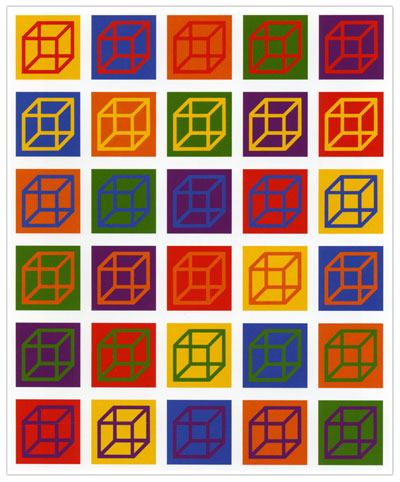


Sol LeWitt - Cubes in Color on Color (2003)


value inversion


Andy Warhol - Marilyn Diptych (1962)


pomo art

Post-Modernism developed from critiques of architectural modernism in the 1970s. By the 1980s, visual art which criticized society was also being referred to as “post-modern”. Post-Modernism is effectively a late Modernism many of whose critiques can be traced back to Modernism itself.

Architects took the lead in the development of Post-Modernism. They criticized the International Style of Modernist architecture for being too formal, austere, and functional. Post-Modern architects felt that International style had become a repressive orthodoxy. It had been adopted by the corporate world and exploited at the expense of its social vision.

Post-Modernist architecture uses more eclectic materials and styles with greater playfulness. Parody of earlier styles is a dominant Post-Modern trait. Another is the refusal to develop comprehensive theories about architecture and social progress.

The ethical touchstone of Post-Modernism is relativism—the belief that no society or culture is more important than any other. Although few Post-Modern artists are pure relativists, they often use their art to explore and undermine the way society constructs and imposes a traditional hierarchy of cultural values and meanings. Post-Modernism also explores power and the way economic and social forces exert that power by shaping the identities of individuals and entire cultures.

Unlike Modernists, Post-Modernists place little or no faith in the unconscious as a source of creative and personal authenticity. They value art not for its universality and timelessness but for being imperfect, low-brow, accessible, disposable, local and temporary.

While it questions the nature and extent of our freedom and challenges our acquiescence to authority, Post-Modernism has been criticized for its pessimism: it often critiques but equally often fails to provide a positive vision or redefinition of what it attacks.


ironic?


Sol LeWitt - Cubes in Color on Color (2003)


jeff koons

...takes mass produced objects from everyday life and exhibits them as art. This thwarts our expectation of art's authenticity and uniqueness. Koons' work deliberately provokes us to consider how art institutions impose cultural and economic value on objects, and challenges our acceptance of their definitions of 'art'. These consumer items are exhibited as art to make us reflect on how our most private dreams of success are shaped by the culture and economy in which we live.


abstraction of painting

The written word became more specialized, more abstract and less and less like pictures. Pictures, meanwhile, began to grow in the opposite direction: less abstract or symbolic, more representational and specific. By the early 1800's, western art and writing had drifted about as far apart as possible. One was obsessed with resemblance, light and color, all things visible...the other rich in invisible treasures, senses, emotions, spirituality, philosophy.

However starting in the late 19th century, modern art movements such as impressionism, expressionism, futurism, dadaism incorporated abstraction back into art. Strict representation styles were of little importance to the new schools. The main thrust was a return to meaning in art, away from resemblance, back to the realm of ideas. Meanwhile, the written word was also changing, poetry began turning away from the elusive, twice-abstracted language of old toward a more direct, even colloquial style (Keats, Whitman). In prose, language was becoming even more direct, conveying meaning simply and quickly, more like pictures. "Meaning" was not abandoned by any means, but authors were definitely moving toward a more straightforward means of communication.

Paintings increasingly took on symbolic, even calligraphic meanings (Klee), while some artists addressed the ironies of words and pictures head-on. Paintings became so "unrealistic" and abstract, that modern art itself became virtually incomprehensible to the average viewer.

- Scott McCloud


Wednesday, March 9, 2011

why modernism

The first effect of modernism was to make high-culture difficult: to surround beauty with a wall of erudition. The hidden purpose was twofold: to protect art against popular entertainment, and to create a new barrier, a new obstacle to membership, and a new rite of passage to the adult and illuminated sphere. To those whom modernism excluded, the movement seemed like a betrayal of the past. Tonality and tunefulness in music; the human image in painting; the pleasing dignity of metre and rhyme - even the homely comfort of a story well told - all these ways in which art had opened its arms to normal humanity were suddenly rejected, like a false embrace. To the modernists, however, the past was betrayed not be modernism but by popular culture. Tonal harmonies had been corrupted and banalised by popular music; figurative painting had been trumped by photography; rhyme and metre had become the stuff of Christmas cards, and the stories had been too often told. Everything out there, in the world of naïve and unthinking people, was kitsch. Modernism was not an assault on the artistic tradition, but an attempt to rescue it. Such was the surprising thought expressed by Eliot and Schoenberg, and their eloquence transformed the high culture of Europe.

- Roger Scruton