Tuesday, May 10, 2011

jmw turner

...Turner's contemporary detractors quite simply possessed no adequate framework within which to understand his achievement. In the early part of the nineteenth century landscape painting was still judged in terms of seventeenth-century Italian idealist and Dutch naturalistic models. By these standards, even Turner's more conventional paintings look poorly executed and disorderly. Lacking a structured idea-space within which to make sense of what Turner was trying to do, the critics simply decided he was mad.


J. M. W. Turner - Dido Building Carthage (1815)


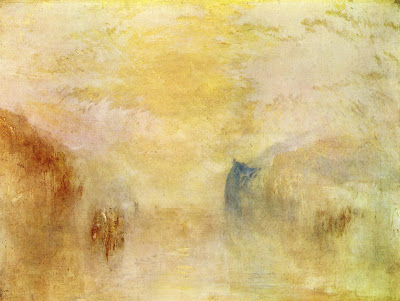
A glance at just two paintings suffices to show how far Turner traveled and how revolutionary a painter he became, especially in his later years. The first, Dido Building Carthage, consciously imitates seventeenth-century landscape painting that Turner modeled himself on in his early period. The second, Sunrise, with a Boat Between Headlands, is a work, entirely characteristic of his late period, "which could be shown with the canvases of any Abstract Expressionist."

No painter except Picasso advanced so far from the painting styles he inherited, or bequeathed to those who came after him such a radically new vision of what painting could be. Turner's influence largely skipped over the art of the next five or six decades, but the revolution he wrought anticipated some of the most profound characteristics of twentieth-century painting.


J. M. W. Turner - Sunrise, with a Boat Between Headlands (1845)


His late paintings, of which Sunrise is a characteristic example, constitute an art in which light and color predominate over form, kinetic force replaces classical stasis, abstraction undermines faith in the reliability of visual representation, and (in seeming anticipation of relativity theory) space and time merge. To put it simply, Turner is the first truly modern painter.10

Great painters do more than produce beautiful or inspiring images. They succeed in transforming the context of painting itself, the space in which it can unfold in the future. This act of artistic paradigm creation is the work of the imaginative intelligence par excellence, transporting the mind to as yet unexplored regions where reason cannot go.

Turner possessed an imaginative intelligence of the highest order. His most radical achievements—liberating color, reducing figural representation to the point of pure abstraction, and making the process of painting meaningful in its own right—were, in modern business parlance, game-changing moves, representing a huge creative leap whose influence we can still recognize in the art of our own time. But the impulses that led him along this path flowed less from his own abundant artistic talent than from his passionate engagement with and integration of two of the most powerful emergent idea-spaces of the nineteenth century: Romantic art and empirical science. The very antithetical tension between them seems to have set his imagination on fire.

Turner's development as an artist affords a window into how the imagination does some of its most radical and exciting work: creating a new idea-space by integrating intelligence embedded in widely separated existing or emergent spaces. The unfolding of Turner's thinking as an artist shows how he allowed key ideas from Romanticism and science to play off one another until they finally—and powerfully—fused.

- Richard Ogle


dutch naturalism

Dutch naturalism was the artistic expression of a vast cultural and social shift taking place in northern Europe. Rapidly expanding global trade and rising prosperity, particularly in the Netherlands and England, was weakening the influence of the Renaissance on these non-Mediterranean countries. An increasingly wealthy commercial class had little use for worshipping an idealized past. At the same time, empirical science entered the cultural mainstream. The latter's objective, fact-based ethos was quite inimical to the idealism of Italian post-Renaissance painting.


Monday, May 9, 2011

prosume culture

A good way to understand the self-assembly of cultural hits and how it creates an ordered, synthetic mental world is by way of contrast. Consider Mozart's opera Don Giovanni. The music and libretto together, express a wide gamut of human emotions, from terror to comedy to love to the sublime, and more in between. The opera represents what is most powerful about the Western canon, namely its ability to combine so much in a single work of art. The libretto, even taken on its own, is worthy of high praise but its integration with Mozart's music brought Enlightenment culture to new heights.

Today, we don't usually receive comedy, tragedy, and the sublime all in ready-to-consume, prepackaged form. As I've stated, we're more interested in this idea of assembling the bits ourselves. For all its virtues, it takes well over three hours to hear Don Giovanni straight through, perhaps four hours with intermission. Plus the libretto is in Italian. And if you want to see it live, a good ticket can cost hundreds of dollars plus travel costs.

So we instead pick up the cultural moods and inputs we want from disparate sources and bring them together through self-assembly. We take a joke from YouTube, a terrifying scene from a Japanese slasher movie, a melody from a three-minute iTunes purchase, and the sublime from our memories of last year's visit to the Grand Canyon, perhaps augmented through a photograph. The result is a rich and varied stream of inner experience.

If you read what many critics say about the arts of the Renaissance or the seventeenth century, it is that human creativity then had a fierceness, a resonance, a brilliance, and a strength that it has not since attained. In the seventeenth century we have Velazquez and Rubens and Rembrandt and Brueghel and Caravaggio painting, Monteverdi composing, and Shakespeare and Milton and Cervantes writing. That's an impressive lineup. It's all so strong and so real. Most of those creations are still available to us in one form or another, at least with a bit of travel or a tolerance for digital reproductions. But in reality this older culture is losing out, in relative terms, to the competition with the internet and the iPod, and thus it is losing out to assembled small bits.

Let's say that you could carry around a perfect copy of a three-dimensional realization of a Caravaggio painting (or if your tastes are more modern make it a Picasso). You would carry a small box in your pocket, and whenever you wanted, you could press a button and the box would open up into life-sized glory and show you the picture. You would bring it to all the parties you attended. The peak of the culture of the seventeenth century (or say the 1920s if you prefer Picasso) would be at your disposal.

Alternatively, let's say you could carry around in your pocket an iPhone. That gives you thousands of songs, a cell phone, access to personal photographs, YouTube, email, and web access, among many other services, not to mention all the applications that have not yet been written. You will have a strong connection to the contemporary culture of small bits. Most people would prefer to carry around the iPhone, and I think they are right.

This preference has led to a corresponding shift in the meaning of cultural literacy. What cultural literacy means today is not whether you can "read" all the symbols in a Rubens painting but whether you can operate an iPhone and other web-related technologies. The iPhone, if used properly, can get you to a website on Rubens as well. The question is not whether you know the classics but whether you are capable of assembling your own blend of small cultural bits. When viewed in this light, today's young people are very culturally literate indeed and in fact they are very often the cultural leaders and creators.

- Tyler Cowen


why pop culture reigns

The difficulty of access influences what kind of enjoyments we pursue. For instance, when it comes to romance not so many people are willing to fly across the country for a peck on the cheek. When the cost of a trip is high, usually you want to make sure it is worth your while. Otherwise why not just stay home? You might drive across town for a kiss if your town isn't too big, or if the traffic isn't too bad.

In the early nineteenth century, it was common for a classical music concert to last five or six hours. If people were walking long distances or arriving by slow coach, the trip had to be worth their while. A concert wasn't just about the music, it was an entire social occasion, involving drinking, the playing of cards, and a big night out. Today the Kennedy Center in Washington, D.C., puts on popular and free "Millennium Stage" concerts for no more than an hour. The hope, which so far has been borne out, is that enough people are nearby, or can get there quickly by cab, car, or Metro, to make the concerts a success. You go hear the music and then you head off to somewhere else.

Some people leave before the hour-long show is over so they can make a quick escape. They're busy and they have somewhere else to go.

If I'm going on a long trip to Brazil, which doesn't have many good English-language bookstores, the cost of getting another book to read can be pretty high. So maybe I'll bring Moby-Dick to reread or these days I'll bring my Kindle, stocked full of classics. The read will take a long time and I am sure it will be gripping, so that book is a good choice for a trip where access to further books is difficult. If I'm at home, access to books is quite easy. I'll grab a huge pile of (free) books from the public library and browse them. If the first nine picks off the shelf are no good it is no big deal; I can easily put them down and find some more, not to mention raid my spare books pile sitting in the dining room. There are five good public libraries within a twenty-minute drive of my house.

The general point is this: When access is easy, we tend to favor the short, the sweet, and the bitty. When access is difficult, we tend to look for large-scale productions, extravaganzas, and masterpieces. Through this mechanism, costs of access influence our interior lives. There are usually both "small bits" and "large bits" of culture within our grasp. High costs of access shut out the small bits—they're not worthwhile—and therefore shunt us toward the large bits. Low costs of access give us a diverse mix of small and large bits, but in relative terms, it is pretty easy to enjoy the small bits.

The current trend—as it has been running for decades—is that a lot of our culture is coming in shorter and smaller bits. The classic 1960s rock album has given way to the iTunes single. The most popular YouTube videos are usually just a few minutes long and most of the time the viewer doesn't stay for longer than the first ten seconds. The two-hour weekday lunch is losing ground even in Spain and Italy. Some radio ads are three seconds or shorter. In the last twenty-live years, virtually all print media have dramatically reduced the length of their articles.

The trend toward shorter bits of culture makes it easier to try new things. If you are taking items in bit by bit the tendency is to indulge your desire to sample.

The very pleasure of anticipating and trying—for its own sake—further encourages the new culture of small bits. When it comes to culture, a lot of the pleasure comes from the opening and unwrap­ping of the gift, so to speak. So you want to be trying new things all the time so you have something to look forward to and so you have the thrill of ongoing discovery.

- Tyler Cowen


Sunday, May 8, 2011

cubism

In the first decade of the twentieth century, art and science both underwent profound revolutions. In 1905, Albert Einstein published his paper on the special theory of relativity that forever changed our conceptions of space and time. In 1907, Picasso painted the picture that irrevocably set painting on a different course. Les Demoiselles d'Avignon, with its fractured planes, was the immediate precursor to cubism, the movement that in many ways constituted the powerhouse for twentieth-century art. As we'll see, the two events were hardly disconnected. In looking at cubism, our main focus will be not on the rise of the movement itself, but rather the way in which it constituted an idea-space in which the law of spontaneous generation began to play a key role in enabling the viewer of cubist paintings to discover meaning in them.


Cubism's status as a revolutionary art movement is hardly in doubt. As the art critic Robert Rosenblum notes, cubism "altered the structure of Western painting to a degree unparalleled since the Renaissance," achieving this goal by means of its "drastic . . . shattering and reconstruction of traditional representations of light and shadow, mass and void, flatness and depth." To grasp how radical a break with the past cubism represents, consider for a moment a typical impressionist painting such as Renoir's Le Moulin de la Galette (painted in 1876—but almost any post-Raphael /pre-Cezanne painting would do). The scene shows several figures seated at a table outside a cafĂ©, while dancers swirl in the town square behind them. Although impressionism of course effected its own important innovations, particularly in regard to the treatment of color perception, it otherwise generally conforms to the classical canons of figurative art. The rules of perspective and foreshortening are obeyed, with more distant figures drawn significantly smaller than those in the foreground and receding along lines radiating from a single focal point. Similarly, light and shadow are treated in a natural and realistic fashion, and the conventional relationship between form and space (i.e., that forms fit the spaces they would occupy in real life) is rigorously observed.


Now let's look at a typical cubist painting, Picasso's Landscape with Poster (1912). Immediately we recognize we are in a completely different kind of pictorial space. Classical perspective has been banished, along with the rest of the grammar of figurative painting. The unity of the picture space has been fragmented into multiple planes representing varying points of view simultaneously, as though what is being captured is the result of someone walking about. The static snapshot viewpoint of Renoir has thus given way to a dynamic configuration—suggestive of movement—in which, as in relativity theory, space and time have merged. Conflicting light sources, suggesting multiple perspectives, are presented within a color scheme that verges on the monochromatic. Figuration, although not abandoned altogether, has been severely subordinated to the abstract geometry of rectangles, trapezoids, and semicircles. The painting, far from attempting to create an illusion of an actual scene, constantly moves in and out of being an autonomous object in its own right, creating its own level of reality and obeying its own internal aesthetic logic. A crucial dimension of this logic, which is representative of the intelligence embedded in the idea-space of cubism as a whole, is the way in which the painting is structured so as to enable the viewer to spontaneously generate patterns of meaning. The viewer shifts from being a passive spectator to an active participant in constructing the painting's interpretation.

Looking at the painting more closely, for example, we notice, in addition to various schematically depicted objects (exteriors walls, doorways, windows), several words displayed quite prominently: Pernod across the top of a bottle, Leon inscribed on a billboard in bold cursive script, and near the bottom of the painting, Kub 10c. Words in fact appear repeatedly in cubist paintings—brand names, numerals, shop signs, and various parts of newspapers. As in the case of other forms of figuration, words and letters move in and out of representing something and becoming aesthetic objects in their own right, integrated into the remaining abstract forms.

This use of letters in cubist iconography, as Rosenblum points out, bears directly on the central issues of how painting relates to the real world and the role of the viewer in shaping how the artwork is experienced.28 In the case of Renoir's painting, life is depicted with sufficient realism to give the illusion of actuality, leaving the viewer with little to do except passively gaze at it. In Picasso's painting, on the other hand, objects are not so much depicted as denoted by means of a visual sign. A flat rectangle with writing on it stands for a billboard, a line in the shape of an inverted J for an archway. Cubist forms thus point to objects in roughly the same way that words do—not by means of realistic figural representation but via visual signs. We are left to read their meanings into them, aided by motifs such as bottles, glasses, archways, and musical instruments that are used over and over. The viewer, in other words, actively shapes the meanings of the painting.

What are we to make of all this? From one perspective, cubism looks like an enormous impoverishment of the rich language of classical figurative painting. "What a loss to French art!" a Russian collector remarked on seeing Les Demoiselles d'Avignon. Yet in breaking decisively with the five-hundredyear-old tradition of depicting the illusion of real life, cubism inaugurated a new era. As one critic put it, "This is the moment of liberation from which the whole future of the plastic arts in the Western World was to radiate in all its diversity."

Cubism shifted from realistic representation to the spontaneous generation of implicit meanings for viewers themselves to discover, play with, and even elaborate. Far from being an impoverishment of art's expressive powers, cubism in fact opened up a vast new array of possibilities. In the process, it changed forever the idea-space in which art evolves. Its new grammar of abstraction, flattening, fragmentation, analytical decomposition of objects, simultaneous perspectives, and multiple ambiguities made possible an immense enrichment of meaning along manifold dimensions, as well as a deepening and broadening of art's metaphysical content.

The constant interplay between elements on different levels, allowing simultaneous meanings (visual and verbal puns) to coexist and multiply, enriched art with irony, humor, and ambivalence. By the same token, it radically undermined any simple reliance on a literal, unitary interpretation of perception. Time and space became integrated in a single flattened plane. Paintings seemed to flip back and forth between semiabstract objects creating their own reality and semifigurational works pulling the viewer back into the real world. Indeed, a typical cubist painting seemed quite profligate in the levels of reality it engendered: almost completely abstract, geometric denotation (a cube for a building), semiaccurate figuration (bottles, buildings, doorways), accurately drawn symbols (letters/words), and finally the intrusion of real objects (collage).

Cubism's witty permutations of these levels and elements and its deliberate use of commonplace objects may seem playful, but it effectively initiated a complete metaphysical reframing of art from the ground up, raising questions destined to shape the progress of art for decades to come: How does a work of art relate to the real world? How is perceptual space organized? What is the role of the viewer—passive spectator or engaged participant, continuously constructing and reconstructing an artwork's meaning? What are a painting's borders, where does art stop and the real world begin, what is inside versus outside the frame?

The depth, range, and power of the revolutionary cubist aesthetics and metaphysics, embodied visually in the radically new space it created for the artistic imagination to unfold in, lies in its discovery of a universal truth about the fundamental calculus of creativity. In effect, cubist art exploits a version of the law of spontaneous generation. Identifiable elements in a painting form a network of related elements (visual resonances and analogies, verbal puns, etc.) that invite the viewer to construct out of them a series of meaningful patterns. Furthermore, as each pattern emerges, it subtly shifts the relationships among the remaining patterns, giving rise to still larger patterns (consider how the recognition of a sexual pun in the middle of a painting might change the interpretation of other elements). Thus in a cubist painting, what shapes the viewer's aesthetic experience is the ongoing generation of meaning that is spontaneous, emergent, and self-transforming. By cocreating with the viewer multiple layers of meaning, this new grammar of painting enabled art to express more authentically the multidimensionality and complexity of human experience.

Cubism vastly enriched the idea-space of twentieth-century art—for artists and viewers alike. In the process it launched a highly energized wave of change that continued to sweep through art over the next seventy years, from constructivism and the Dutch De Stijl movement to conceptualism and pop art.

As any art history textbook will tell you, cubism was invented by Braque and Picasso. The workings of genius in this achievement are not to be denied. But let's ask Kauffman's intriguing question: Whence this order? Did it spring fully formed from the heads of Braque and Picasso? Are they alone responsible for one of the greatest revolutions in the history of art? Or were there, in Kauffman's phrase, "vast veins of spontaneous order" lying at hand that Braque and Picasso discovered and mined? In short, was the new order cubism represented in reality an example of coevolutionary change, the spontaneous and emergent result of two painters of genius interacting with the laws of self-organization?


The foregoing analysis of cubism suggests precisely that. The break cubism made with the past was above all a break with realistic representation in favor of abstraction. Not the purely nonrepresentational abstraction of Kandinsky, but a much more analytic, formal, geometric abstraction. That this occurred at the very same time that Einstein was overthrowing Newton by reintroducing geometry into physics, while simultaneously undermining our commonsense faith in the reality depicted by falling apples, is no mere coincidence, as Arthur I. Miller has brilliantly demonstrated in his recent book, "Einstein, Picasso."

It was part of Picasso's genius to have intuitively recognized very early the significance of this historic scientific shift. Furthermore, once the basic move to abstraction had been made, much else followed almost automatically. Abstract form, like mathematics itself, proved to be a rich generative engine. There are always more sets of things than things. Picasso and Braque, influenced by radical new theories in mathematics and physics that destroyed the unity of a single perspective, discovered this for themselves, and then created an art that allowed the viewer to discover it too. In an abstract space, relationships come to the fore and spontaneously multiply.

Each new element adds value well beyond its intrinsic content, interacting with all the other elements in the picture. The result could be chaos, of course, subjecting the viewer to a dizzying calculus of forms, only a small subset of them meaningful. In reality, Picasso and Braque avoid that pitfall for the most part (though some of Picasso's late cubist paintings flirt dangerously with it) by carefully educating the viewer's eye to notice certain fairly obvious sets of relations first. This has the effect of progressively building a model of meaningful relations in the viewer's mind that can then be used to seek and recognize more subtle visual and linguistic plays while disregarding meaningless ones. The mind seems innately programmed to seek the same patterns over and over. The fit get fitter.

Cubism broke with a five-century-old tradition of figurative art by reaching out to a science that was becoming radically more abstract and geometric, and in the process overturning our commonsense view of the world. This move created a weak tie that connected art with a whole domain of thought that was far removed from it. And just as weak ties turn out to be better at getting you a new job than your immediate circle of friends, so they are better at producing creative breakthroughs. Connecting to the hotspot of early-twentieth-century physics and the focus on abstract geometric form that it triggered released an avalanche of new ideas into the art world, ideas that spontaneously multiplied and are still playing themselves out. Creative ideas frequently lead to exponential growth. What hasn't always been grasped is that, conversely, under the right circumstances the exponential growth of ideas can lead to creative breakthroughs.

- Richard Ogle


Saturday, May 7, 2011

art as exorcism

“…I understood what the purpose of the sculpture was for the Africans . . . [The scultpures] were weapons. To help people stop being dominated by spirits, to become independent. Tools. If we give form to the spirits, we become independent of them . . . I understood why I was a painter. All alone in that awful museum, the masks, the Red Indian dolls, the dusty mannequins. Les Demoiselles d'Avignon must have come to me that day, but not at all because of the forms: but because it was my first canvas of exorcism.”

The Demoiselles marked a profound turning point, not just for Picasso but for modern art itself. It is one of the most sublimely beautiful and at the same time deeply disturbing works of art ever produced, by some standards the most important painting of the twentieth century. Prior to completing it, Picasso had seemed to race through one style after another, drawing inspiration from artists as far apart as El Greco and Toulouse-Lautrec, and periods ranging from ancient Greek to postimpressionist. Now he finally knew who he was as a painter.

The painting was unquestionably a breakthrough in purely formal terms. With its drastically flattened perspective and fractured planes, it leaped far beyond anything Cezanne had achieved, clearing the way for cubism's dazzling recomposition of forms, and smashing forever the idea that the main purpose of art was to produce beautiful, realistic-looking illusions. Western art had finally sprung free of its compulsion to render the human face and figure realistically in terms of its skeletal structure and musculature. Instead, shape, volume, and plane were now in the grip of a tradition that had never bowed to the ethic of representation.

Above all, however, the Demoiselles was a revolution in function. Perhaps no painting of human flesh so shocks us in its depiction of the artist's agonized relationship to his subject matter. As Picasso himself makes clear, what he overwhelmingly felt enthused by was the essentially magical purpose of African sculpture. By reframing art as exorcism, as an act of protecting oneself from domination by "unknown, threatening spirits," Picasso irrevocably changed the twin roles of artist and spectator. Painting transcended the status of object, effectively becoming a way of propitiating our spiritual and psychological demons. Cubism has come and gone, but the radical transformation Picasso prompted in how we look at art and the act of painting, as well as our own involvement in it as viewers, remains deeply embodied in the culture to this day.


Pablo Picasso - Les Demoiselles d'Avignon (1907)


Tuesday, April 19, 2011

modern classical music

Twentieth-century classical composition, the subject of this book, sounds like noise to many. It is a largely untamed art, an unassimilated underground. While the splattered abstractions of Jackson Pollock sell on the art market for a hundred million dollars or more, and while experimental works by Matthew Barney or David Lynch are analyzed in college dorms across the land, the equivalent in music still sends ripples of unease through concert audiences and makes little perceptible impact on the outside world. Classical music is stereotyped as an art of the dead, a repertory that begins with Bach and terminates with Mahler and Puccini. People are sometimes surprised to learn that composers are still writing at all.

Yet these sounds are hardly alien. Atonal chords crop up in jazz; avant-garde sounds appear in Hollywood film scores; minimalism has marked rock, pop, and dance music from the Velvet Underground onward. Sometimes the music resembles noise because it is noise, or near to it, by design. Sometimes, as with Berg's Wozzeck, it mixes the familiar and the strange, consonance and dissonance. Sometimes it is so singularly beautiful that people gasp in wonder when they hear it. Olivier Messiaen's Quartet for the End of Time, with its grandly singing lines and gently ringing chords, stops time with each performance.

- Alex Ross